
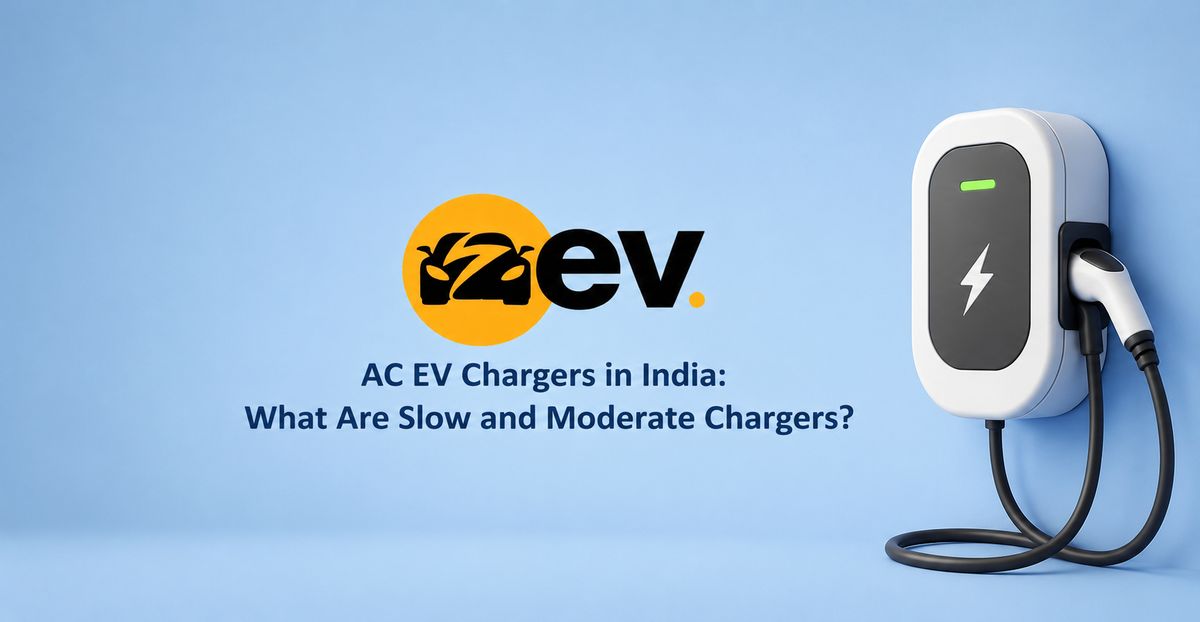
AC EV chargers are rated in the range of 3.3 kW, 7.2 kW, 11 kW, and 22 kW. AC EV chargers are usually suited to installation at locations where an electric vehicle has been stationed for some hours, such as residences, basement of residences, offices, and shopping centers. In India, the AC charging connector standard used for most EVs is Type 2. The charging infrastructure of EVs in India is regulated under IS 17017 standards, which include AC charging systems and connectors.
If you're comparing electric cars, BudgetEV can help you look beyond range and price by checking an EV's charging capability before you shortlist it.
What Are AC EV Chargers?
An AC charger provides alternating current (AC) power to an electric vehicle. The vehicle's onboard charger then transforms this power into the DC that the battery uses.
While DC fast chargers are powerful, the AC charger usually functions better when the vehicle does not need to rush out.
This feature makes the AC charger suitable for:
- Parking at residences and apartments
- Parking lots at offices
- Malls
- Hotels
- Long-term parking facilities
- Home overnight parking
The major benefit lies in the ease of use.
What are the Standard AC Charging Rates?
AC charging can include different charging rates.
AC power
Typical use
3.3 kW
Basic/slow home charging
7.2 kW
Faster residential charging
11 kW
Homes and commercial locations with suitable electrical capacity
22 kW
Higher-power AC public charging
But having a 22 kW AC charger does not mean your electric car will have a 22 kW charging rate. That will depend on your EV's ability to take in that amount of electricity.
This is something that should be noted when looking at the specs of your electric vehicle.
Is Type 2 the Main AC Connector for Electric Vehicles in India?
Type 2 is one of the most commonly used AC connectors for electric vehicles in India.
IS 17017 standard has specified the requirements for electric vehicle plugs, socket-outlets, vehicle connectors, and vehicle inlets in Indian Standards.
It implies that customers need to consider not only the connector compatibility but also its maximum AC charging capacity.
Is AC Charging Enough for Everyday Use of EVs?
For most EV drivers, the answer is yes.
If you keep your car overnight or park it for some hours at work, then the battery will get recharged through an AC charger.
For instance, in case the commuter drives to his office in the morning and parks his car until evening, he can get the battery recharged without needing the fast charger DC.
This really depends on the size of the battery, driving mileage, capacity of the charger, and parking hours.
Before purchasing any electric car or charging unit, you need to consult BudgetEV and compare different EVs based on their charging parameters among others.
AC Charger or DC Charger: Which Is Right for You?
AC charging is better for daily parking that takes longer time, whereas DC charging works well when you want to get much more power in less time.
AC charging is ideal for regular charging when you drive in cities, and DC fast charging is needed when you travel on highways.
Final Word
Although the AC chargers for EVs are slow compared to the DC fast chargers, they still do not lose their value because of their ability to charge in a convenient way when the car is already parked.
The knowledge of the differences in 3.3 kW, 7.2 kW, 11 kW and 22 kW AC chargers is valuable for any Indian buyer of an EV in order to find a car that suits his lifestyle.
See BudgetEV to learn more about different electric cars specifications.